Monday 01 / December / 2025
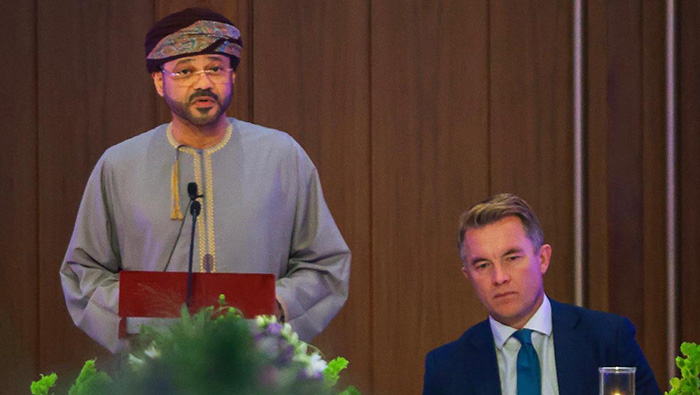
Muscat: Foreign interventions rarely succeed because they almost always complicate the task of conflict resolution, Oman’s Foreign Minister His Excellency Sayyid Badr Hamad Hamood Al Busaidi told policymakers attending the Muscat Mediation Retreat.
In his address, on Sunday evening, the Foreign Minister expressed in public what many well-informed people think in private.
He explained that those ordering and executing interventions typically do not understand local conditions, nor have they formed the necessary relationships to achieve their political goals. Their actions increase the number of parties involved in a conflict, introduce additional issues into the resolution process, and, most concerningly, undermine international law.
Rather than focusing on clear violations of international law - such as Russia’s war in Ukraine or Israel’s actions in Palestine - Sayyid Badr highlighted less explicit violations: cross-border assassinations of politicians, mediators, and scientists, citing Israel’s actions in Iran, Lebanon, Yemen, Palestine, Qatar, and other states; foreign support for parties in civil wars, as seen in Syria, Yemen, and Sudan; and threats of annexation, judicial interference, and invasion, for example, U.S. statements regarding Brazil, Canada, Greenland, and Venezuela.
He warned that the world may be descending into a state where foreign intervention is increasingly seen as an acceptable element of multilateralism rather than a violation of shared principles and legal frameworks.
Oman called for collaboration to protect the frameworks and conventions that have limited conflict since the end of World War II.
Sayyid Badr explained that agreements such as the 1945 UN Charter helped reduce the seizure of territory to less than 10% of what it had been in the late 1800s. While violent interventions continued - such as in Afghanistan in 1979, Vietnam in the 1960s, and Grenada in 1983—they were no longer the norm, and perpetrators were subject to near-unanimous condemnation and punitive
action.
He cited NATO’s 1999 intervention in Yugoslavia as a turning point. The objective was honourable: to stop ethnic cleansing and bring the perpetrators to trial. But inadvertently, it sparked a devastating “global mission creep,” where states began justifying violations of international law by claiming their actions were ethical.
In Afghanistan, Iraq, Libya, Syria, Yemen, and Sudan, this global mission creep has had detrimental and deadly repercussions for the people of each country, the region, and the wider international community.
To prevent a return to pre-20th-century disorder, Sayyid Badr made three recommendations: first, all interventions must be clearly, unanimously, and formally condemned; second, a global conference should be held for states to reaffirm their commitment to international law; and third, the judgments of the International Court of Justice must be made enforceable. He expressed hope that the Oslo Forum would work diligently and collaboratively to achieve these goals.
The Muscat Mediation Retreat is part of the Oslo Forum, a world leading platform for peacemaking. Attendees in November 2025 included ministers and officials from Iran, Egypt, Norway, Qatar, Saudi Arabia, UAE, Bahrain, Jordan, Libya, UK, Lebanon, Turkiye and Switzerland, as well as representatives from the United Nations and the Secretary General of the GCC.