Thursday 10 / September / 2026
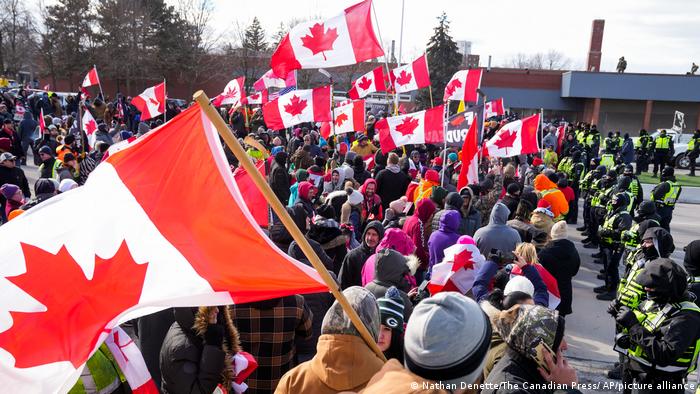
Access to a key trade route between Canada and the US remained blocked late on Saturday as dayslong protests against coronavirus restrictions continued in a number of Canadian cities, including the capital, Ottawa.
Some 180 protesters were blocking the Ambassador Bridge linking Windsor in the Canadian province of Ontario with the US city of Detroit, even after Canadian police succeeded in persuading demonstrators to move some trucks barricading the crossing earlier in the day. A first arrest was made by Windsor police on Saturday evening for a criminal offense in relation to the demonstration.
The bridge carries a quarter of all trade between the two countries, and the disruptions to traffic are believed to have caused millions of dollars in additional cost in the automobile sector alone so far. An order to end the blockade was issued by a court on Friday.
Police say many demonstrators 'aggressive'
In Ottawa, where protesters have been encamped since a convoy of truckers arrived in late January, police say some 4,000 demonstrators were gathered on Saturday. Many people arrived from outside the city to join the protests.
Although politicians and residents have called for the protests to be dispersed, police say they are limited in what they can do.
"Safety concerns — arising from aggressive, illegal behavior by many demonstrators — limited police enforcement capabilities,'' Ottawa police said in a statement late Saturday.
They said a joint command center had now been set up together with the Ontario Provincial Police and the Royal Canadian Mounted Police.
Both federal and provincial leaders say they are not able to tell police what to do.
Prime Minister Justin Trudeau, who has called the protesters a "fringe" of Canadian society, has so far rejected calls to bring in the military. But his office has said authorities would not hesitate to pull out all the stops, if necessary.
"The prime minister stressed that border crossings cannot, and will not, remain closed, and that all options are on the table,'' it said in a statement late Saturday after Trudeau met with senior officials.
The protests in Ottawa have provoked complaints by many residents, with protesters often displaying loud or otherwise offensive behavior. On Saturday, some tore down a fence that had been erected around the National War Memorial after demonstrators urinated on it.
The majority of Canadians have supported the country's relatively strict pandemic measures, which are seen as having played a big role in keeping the COVID-19 death rate down to a third that of the neighboring US.
Protest spread around the world
Demonstrations were also seen on the other side of the country, with protesters disrupting another border crossing between Surrey in British Columbia and Blaine in the US state of Washington. Border crossings in Alberta and in Manitoba were also affected.
The protests in Canada, which police say have been partly funded by US supporters, have inspired similar actions in a number of other countries,including France, the Netherlands, Australia and New Zealand. The US Department of Homeland Security has also warned that truck convoys may be being planned in the United States.
Even as the protests continue in Canada, a number of the measures are being lifted as infections drop again following a surge caused by the omicron variant.