Wednesday 22 / July / 2026
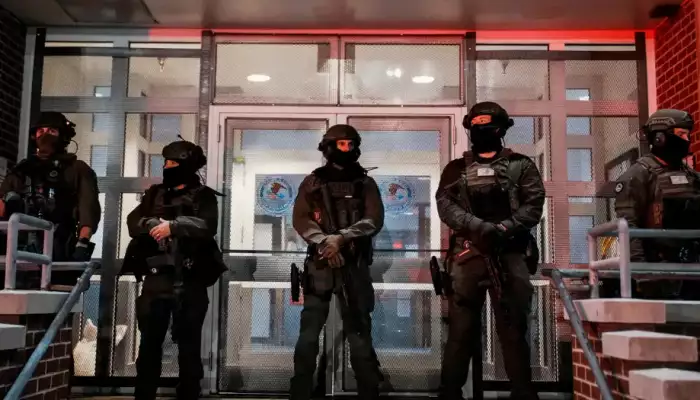
New York: The "Rapid Response 47" X account, which is affiliated with the White House, has published a video purportedly showing Nicolas Maduro being escorted by DEA agents in New York.
The post is accompanied by one line caption, reading: "Perp walked."
A "perp walk," short for "perpetrator walk," is a controversial law enforcement practice in the US.
Also known as a "frog march," it involves a recently arrested suspect being paraded in front of news cameras and reporters, often while handcuffed.
While Nicolas Maduro's capture and removal by the US has been widely celebrated by Venezuelans in exile, people in Venezuela now face an uncertain future.
DW spoke to some Venezuelans about how they are feeling in the aftermath of the US attack on their country and the overthrow of a leader who has been in power since 2013.
Venezuela's Supreme Court has ordered Vice President Delcy Rodriguez to assume the role of acting president in Nicolas Maduro's absence.
Maduro was detained early Saturday morning in a US operation and flown to New York to face drug trafficking charges.
According to the court ruling, Rodriguez will assume "the office of President of the Bolivarian Republic of Venezuela, in order to guarantee administrative continuity and the comprehensive defense of the nation."
What are the charges against Maduro?
Nicolas Maduro and his wife, Cilia Flores, are scheduled to appear before a judge in New York on an as yet unspecified date.
According to US Attorney General Pamela Bondi, they have been indicted in the Southern District of New York.
Maduro and his wife have been charged with:
Narco-Terrorism Conspiracy
Cocaine Importation Conspiracy
Possession of Machineguns and Destructive Devices
Conspiracy to Possess Machineguns and Destructive Devices against the United States
What does the indictment say?
The indictment accuses Maduro of leading a 'a corrupt, illegitimate government that, for decades, has leveraged government power to protect and promote illegal activity, including drug trafficking'
It also says Maduro has been the 'de fact but illegitimate ruler' of Venezuela, where he 'remained in power despite losses in recent elections'
Are the charges against Maduro legal?
According to legal experts, drug trafficking and gang violence are considered criminal activity and do not rise to the accepted international standard of an armed conflict that would justify a military response.
Matthew Waxman, a law professor at Columbia University who specializes in national security law, told Reuters, "A criminal indictment alone doesn't provide authority to use military force to depose a foreign government, and the administration will probably hang this also on a theory of self-defense."
Rebecca Hamilton, a law professor at the American University in Washington DC, told DW that bringing the Venezuelan president before a US court violates Maduro's immunity as a "sitting head of state."
"It doesn't matter whether or not the allegations against Maduro are correct as a factual or legal matter, as long as he is the sitting head of state. He can't be brought before a US domestic court," Hamilton stressed.
Many locals wanted Maduro out — will they protest for change?
Oliver Della Costa Stuenkel, a senior fellow at the Carnegie Endowment and a fellow at the Harvard Kennedy School in Washington DC, has told DW that the US intervention in Venezuela can be viewed as a revival of the Monroe Doctrine, a 19th century US foreign policy that considered Latin America to be within the US sphere of influence.
"The United States considers its near abroad, Latin America, including South America, also as its sphere of influence, and has seen Maduro as an irritant, as somebody who's been opposing the US attempts to project its influence, somebody who's strategically close to Cuba, to Iran, Russia and China, which are seen as threats from a US perspective to its attempt to increase its influence in Latin America," Steunkel said.
Stuenkel also said he expects Maduro allies in the Venezuelan government will look to "mobilize" people and have them protest against the US attack.
"The next hours will be really crucial because a lot of Venezuelans will be seeing if there is signs of ruptures or of tensions within the regime. And I think that will ultimately decide whether the remaining part of the government can stay in power or if we'll see an actual transition," Stuenkel added.
The Venezuelan diaspora erupted in celebration following the capture by US forces of President Nicolas Maduro.
Millions of Venezuelans have fled the country under Maduro's government, in one of the largest migrations in recent history.
Since 2014, the year after Maduro came to power, 7.7 million Venezuelans — 20% of the population — have left the country, according to the UN International Organization for Migration.
"We are free. We are all happy that the dictatorship has fallen and that we have a free country," said Khaty Yanez, a Venezuelan woman who has spent the last seven years in Santiago, Chile, as quoted by Reuters.
Milagros Ortega, a Venezuelan migrant living in Peru's capital, Lima, whose parents are still in Venezuela, said she hopes to return. "Knowing that my dad was alive to see the fall of Nicolas Maduro is very emotional. I would like to see his face," she said.
Meanwhile, Venezuelans in South Florida chanted "liberty" and draped themselves in Venezuelan flags to celebrate the US military operation that captured Maduro.
"We're like everybody — it’s a combination of feelings, of course," said Alejandra Arrieta, who came to the US in 1997.
"There’s fears. There’s excitement. There’s so many years that we’ve been waiting for this. Something had to happen in Venezuela. We all need the freedom," Arrieta told AP.
Who is in charge in Venezuela following Maduro's capture?
Following the US military's capture and ouster of President Nicolas Maduro, uncertainty is gripping Venezuela, as people are left to wonder who is now in charge of their country.
Long lines snaked through supermarkets and outside gas stations as Venezuelans, accustomed to crises, stocked up once again.
Though small pro-government rallies broke out in some areas of Caracas, most of the streets in this country of 29 million were deserted.
"What will happen tomorrow? What will happen in the next hour? Nobody knows,” said Caracas resident Juan Pablo Petrone, as cited by the AP news agency.
President Donald Trump has said the US will "run" the country, although details of the White House's plans have not been disclosed.
Trump said Delcy Rodriguez, one of Maduro's most trusted aides and his vice president since 2018, had been sworn in as president and suggested she would be involved in the transition of power.
But in remarks on state television, Rodriguez pushed back, demanding the immediate release of Maduro and his wife, Cilia Flores and calling Maduro Venezuela's "only president."
Meanwhile, the Nobel Peace laureate and Venezuelan opposition leader Maria Corina Machado has said Edmundo Gonzalez, widely seen as the victor of elections in 2024 and legitimate president, should be sworn in.
France's President Emmanuel Macron has said he supports Machado's call for Gonzalez to become Venezuela's next president.
Expert highlights 'many violations of international law' in US attack
Rebecca Hamilton, a professor of law at the American University in Washington, DC, has told DW that the US attack on Venezuela and the capture and indictment of its president have already resulted in many violations of international law, and more may emerge in the coming days.
She explained that Trump's claim that the United States would take over and "run" Venezuela is a crime of aggression.
"You cannot, under international law, just go and take over another country, let alone loot its oil, as also seems to be part of the emerging plan," Hamilton said.
"And then finally this idea that you can haul Maduro before a US court when he is a sitting head of state, violates another international law rule around something called head of state immunity," she added.
"It doesn't matter, in fact, whether or not the allegations against Maduro are correct as a factual or legal matter, as long as he is the sitting head of state. He can't be brought before a US domestic court," Hamilton stressed.




