Sunday 05 / April / 2026
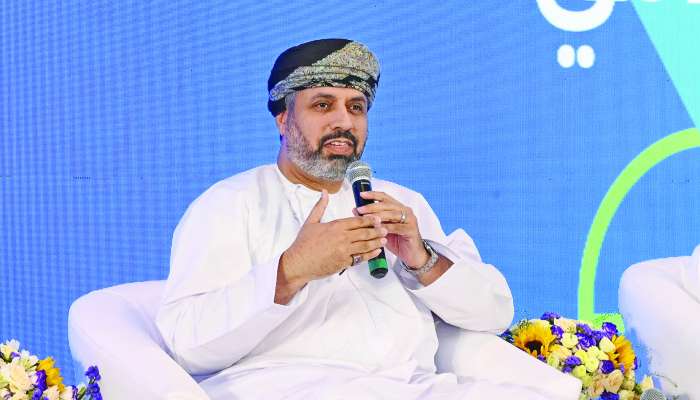
Muscat; The Ministry of Labour, during its media meeting held today in Muscat, reviewed the key achievements and initiatives accomplished. It also discussed future approaches for the labour and human resource development sectors in alignment with the national vision and sustainable development requirements.
Dr. Mahad Said Ba'awain, Minister of Labour stated that the number of job seekers until the end of last November reached 74,000. He added that through the "Sahim" initiative, a number of job seekers were accommodated and the majority of them were granted permanent contracts, with the rest awaiting the availability of financial grades.
For his part, Khalid Salim Al Ghammari, Undersecretary of the Ministry of Labour for Labour, indicated that 50,000 jobs targeted in the private sector during 2026 will be distributed across two categories: part of them for replacement in the oil, gas, logistics, and tourism sectors, and the second will be provided directly or through wage support or training. He noted that in 2025, as many as 2,000 citizens from low-income families and persons with disabilities were employed in the private sector, in addition to providing initiatives with financial grades in the government sector for persons with disabilities for the current year.
The meeting included visual presentations on the performance of the labour and human resource development sectors and the Eleventh Five-Year Plan of the Ministry of Labour.
Ammar Salim Al Sa’adi, Director General of Labour at the Ministry of Labour, pointed out that 36,413 employment opportunities and 15,069 job opportunities through training coupled with employment and replacement were provided in 2025. He also announced that the sectoral committee in the field of employment governance announced the provision of 13,000 job opportunities. In the self-employment system, 2,300 professions were registered, and more than 4,000 Omanis were replaced in technical and leadership positions.
He stated that in the field of negotiation efforts, the Ministry's Economic Committee in 2025, regarding cases of terminated services, succeeded in retaining 713 cases. In the field of following up on employment and terminated services, contracts for 2,146 individuals were renewed. In the field of negotiations, 4,388 cases were retained. The number of beneficiaries of employment security scheme reached 660. He noted that more than 141,000 establishments are registered in the Wage Protection System.
For his part, Salim Hamoud Al Jabri, Director General of Regulation and Job Classification at the Ministry of Labour, pointed out that the improvement rate in performance results for the safety of applying the individual proficiency system in the human resource development sector reached 95%.
He said that 48 units have applied management practices, studies, and research within the framework of the institutional innovation and change management system. He indicated that the Ejada system for measuring individual and institutional performance included the application of the institutional proficiency system by 67 government units, as more than 150 workshops and awareness meetings on institutional proficiency were implemented. He clarified that the national system for institutional innovation and change management included 48 units that applied practices for innovation and change management and 4 research studies.
He pointed out that 300 employees obtained the international Thomas certificate as certified assessors, and 89% of administrative apparatus units determined patterns for analyzing personal and leadership traits within the Ejada matrix for human resource management.
Meanwhile, Abdullah Murad Al Malahi, Assistant Director General for Planning and Labour Policies, focused in his visual presentation on the Ministry's qualitative outputs, programs that confirm the impact, and the priority of the state's administrative apparatus, while following up on beneficiaries' experiences through field visits to monitor their satisfaction and identify improvement opportunities.
The presentation included efforts to complete the electronic transformation of services, activate linkage with government entities, and develop comprehensive digital systems and programs to provide an accurate database for measuring productivity and evaluating performance, contributing to raising the quality of public services and labour market efficiency.
He stated that the Eleventh Five-Year Plan (2026-2030) includes strategic programs that keep pace with future labour market trends, reaching 17 programs distributed across 3 priorities, including 12 programs in the labour market and employment.
He added that the labour market and employment priority during 2026-2027 includes accelerating the absorption and employment of job seekers in the public and private sectors and self-employment, developing employment programs for job seekers from special categories, and developing legislation and national competencies to monitor qualitative compliance for labour market inspection.
He indicated that the labour market and employment priority during 2028-2029 includes empowering national competencies through self-employment platforms, institutional partnership to employ competencies in priority economic sectors, and empowering national cadres to occupy supervisory, specialized, and technical positions in the private sector.
He affirmed that in 2026, as many as 60,000 job opportunities will be provided, represented by 10,000 opportunities in the government sector, 33,000 in the private sector, and 17,000 through national training and qualification programs.
A short film on the Ministry's digital transformation was screened during the meeting, clarifying the role of electronic systems in monitoring performance indicators, enhancing beneficiary experience, developing training programs coupled with replacement, and applying smart management of institutional processes, which supports institutional innovation and enhances governance.