Friday 26 / June / 2026
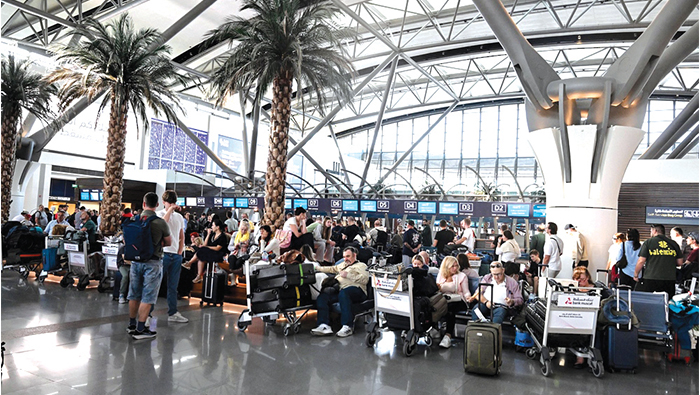
Muscat: As airspace closures ripple across the Gulf following the escalating conflict involving the United States, Israel and Iran, Oman has rapidly emerged as a critical aviation lifeline for stranded travellers, with Muscat International Airport turning into the region’s main emergency transit hub.
After nearly a week of disrupted air travel across GCC nations, Oman remains normal, providing relief to thousands of passengers whose journeys were abruptly halted when regional airspace shut down.
Flights across several Gulf countries were suspended or drastically curtailed after the US–Israel strikes on Iran and subsequent retaliatory military actions raised security concerns over regional air corridors. The closures triggered a chain reaction across major aviation hubs including Dubai International Airport and Hamad International Airport in Doha, forcing airlines to cancel or reroute hundreds of flights.
In contrast, Oman’s airspace has remained open and operational, allowing the Sultanate to absorb diverted aircraft and stranded passengers from across the region.
National carrier Oman Air and Oman’s budget airline SalamAir have significantly increased flight frequencies over the past several days to meet the sudden spike in demand.
Both airlines have added additional services to key destinations in Asia, Europe and Africa while also deploying larger aircraft on busy routes to accommodate stranded travelers attempting to leave the region. “We have added extra daily flights to London, Istanbul, Kuala Lumpur, Cairo, Mumbai and Bangkok,” an official at Oman Air said.
Air India Express has also added additional flights to connecting Muscat to Delhi and Mumbai.
Chartered flights have also surged, with private aviation companies and international airlines arranging emergency services from Muscat International Airport to cities across India, Southeast Asia and Europe.
Airport officials confirmed that aircraft movements in Muscat have risen sharply since the start of the crisis, with several foreign carriers temporarily rerouting operations through Oman to bypass restricted airspace.
144 flights departed from Muscat on Thursday, compared to 125 a week earlier, according to data from Flightradar24.
The flight-tracking service also said that private aircraft account for nearly one-third of takeoffs and landings.
The sudden aviation shift has also triggered an unusual movement of travelers across land borders.
Travel agencies in Oman reported a steady stream of passengers arriving from the United Arab Emirates after flights in Dubai, Abu Dhabi, and other major UAE hubs were disrupted. “A large number of convoys of private cars, hired SUVs and intercity buses have been ferrying passengers from UAE cities to Muscat, to catch international flights still operating from Oman,” said a travel agent based in Muscat.
Hotels have also reported a sharp rise in occupancy, with many passengers staying overnight while waiting for onward connections. “We have got a large number of tourists from the recent days,” confirmed a hotel manager.
Civil Aviation authorities have coordinated closely with airlines and airport operators to ensure that additional aircraft movements can be accommodated without affecting safety or operational efficiency.
For thousands of international travellers stranded by the crisis, Oman’s open skies have become a rare window of stability in an otherwise chaotic aviation landscape.
Passengers from India, Europe, Southeast Asia and Africa are now rerouting their journeys through Muscat, transforming the city into one of the most important transit points in the region almost overnight.
With tensions still high and several regional airspaces remaining restricted, Muscat’s role as the Gulf’s temporary aviation lifeline is expected to continue in the coming days.