Saturday 17 / October / 2026
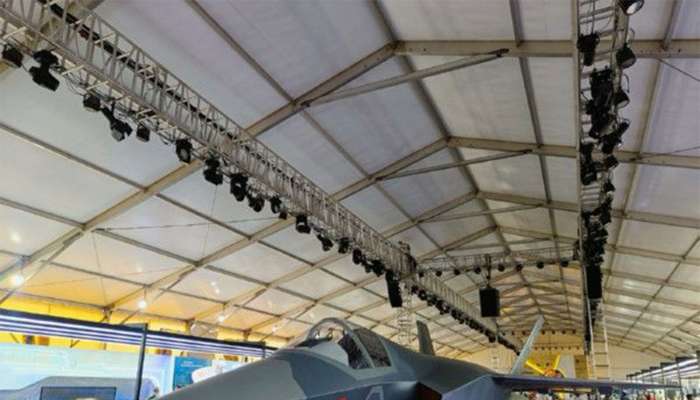
New Delhi: The race for air superiority in the twenty-first century is increasingly being shaped by stealth, artificial intelligence, advanced sensors and network-centric warfare.
In this rapidly evolving landscape, India’s Advanced Medium Combat Aircraft (AMCA) programme has emerged as one of the country’s most ambitious technology missions, signalling a decisive step towards joining the elite league of nations capable of designing and producing fifth-generation fighter aircraft.
What began as a long-term vision for indigenous aerospace capability is now moving into a new phase of execution.
With industry participation expanding, critical technologies maturing and manufacturing plans gathering pace, the AMCA programme is becoming a symbol of India’s broader transformation from a major defence importer to a developer of advanced military platforms.
The latest developments in 2026 suggest that the project is no longer merely an aircraft programme.
It is evolving into a national aerospace ecosystem capable of driving innovation across manufacturing, materials science, software engineering, avionics and defence technology.
Building India’s most advanced fighter aircraft
The AMCA is being developed as India’s first indigenous fifth-generation stealth fighter aircraft.
Conceived to meet the future operational requirements of the Indian Air Force, the aircraft is expected to combine stealth characteristics, supercruise capability, advanced electronic warfare systems, sensor fusion and next-generation avionics.
Designed by the Aeronautical Development Agency with support from the Defence Research and Development Organisation and industry partners, the programme represents one of the most technologically sophisticated aerospace projects ever undertaken in India.
The aircraft is intended to provide capabilities comparable to modern fifth-generation combat platforms operated by leading global air forces.
The emphasis is not only on combat performance but also on creating an indigenous ecosystem capable of sustaining future aerospace innovation.
Recent progress indicates that the programme is moving steadily from the design and development stage towards industrial implementation.
Private industry enters the core of fighter manufacturing
One of the most significant developments in the AMCA story has been the increasing participation of India’s private sector.
Reports indicate that major industrial groups, including Tata Advanced Systems, Larsen & Toubro and Bharat Forge, have been shortlisted for critical roles in the project’s manufacturing ecosystem.
The move reflects a broader shift in India's defence production strategy, where private industry is increasingly becoming a key partner in high-technology programmes.
The participation of large industrial players is expected to strengthen production capabilities, accelerate technology absorption and enhance supply chain resilience.
It also signals growing confidence in the ability of the Indian industry to handle complex aerospace manufacturing requirements involving precision engineering, advanced composites and sophisticated assembly processes.
For the aerospace sector, this collaboration represents a new model in which government agencies, research institutions and private enterprises work together on a national technology programme.
Indigenous technologies drive the programme
A defining feature of the AMCA initiative is the emphasis on indigenous technology development.
Recent reports have highlighted progress in the creation of indigenous radar cross-section simulation software, an important capability in stealth aircraft design.
The software reportedly enables engineers to analyse and optimise stealth characteristics more efficiently while significantly reducing simulation times.
The development is noteworthy because stealth technology remains among the most complex domains in military aviation.
The ability to design, test and refine low-observable characteristics through domestic software tools strengthens India's technological self-reliance in a highly specialised field.
The programme is also expected to integrate advanced mission computers, sensor fusion technologies, electronic warfare systems and sophisticated avionics developed through domestic research and industrial partnerships.
These efforts align with India's broader objective of building strategic capabilities across critical technologies rather than relying exclusively on imported solutions.
Aligning with global aerospace manufacturing standards
The AMCA programme is increasingly being positioned within a global aerospace manufacturing framework.
Industry discussions indicate that the project is being aligned with international production practices, advanced digital engineering techniques and modern aerospace certification standards.
This approach reflects lessons learned from successful aerospace programmes worldwide, where digital design, simulation-based testing and integrated manufacturing systems have transformed aircraft development.
The adoption of such methodologies is expected to enhance efficiency while creating opportunities for Indian companies to participate in global aerospace supply chains.
Beyond the aircraft itself, the programme is helping develop expertise in areas such as advanced materials, additive manufacturing, precision machining and digital engineering.
These capabilities have applications that extend beyond military aviation, contributing to India's broader industrial and technological development.
Strengthening India’s aerospace ecosystem
The significance of AMCA extends well beyond defence procurement.
Large aerospace programmes often act as catalysts for innovation ecosystems, creating opportunities for universities, research laboratories, start-ups and manufacturing firms.
India’s experience with indigenous defence platforms over the past decade has demonstrated how complex programmes can stimulate technological advancement across multiple sectors.
The AMCA initiative is expected to generate demand for specialised components, avionics systems, software solutions, advanced materials and testing infrastructure.
This ecosystem effect is particularly important because aerospace development requires the integration of thousands of technologies and components across numerous disciplines.
As suppliers, researchers and manufacturers contribute to the programme, the broader aerospace sector stands to gain valuable expertise and industrial capability.
A strategic vision for future air power
The global strategic environment is increasingly characterised by rapid technological change. Air forces are investing heavily in stealth, autonomous systems, artificial intelligence and networked warfare capabilities.
The AMCA programme reflects India's determination to remain at the forefront of these developments.
By developing an indigenous fifth-generation fighter, India aims to strengthen long-term technological capabilities while ensuring that future defence requirements can be supported by domestic expertise and industrial capacity.
The programme also complements a wider transformation underway in India's defence sector, where indigenous aircraft, helicopters, missiles, drones and advanced electronics are becoming increasingly central to military modernisation.
The cumulative effect is the emergence of a more self-reliant defence industrial ecosystem capable of delivering complex platforms and technologies.
From design ambition to aerospace reality
The journey towards a fifth-generation fighter aircraft is among the most demanding endeavours in modern engineering. It requires mastery across disciplines ranging from aerodynamics and propulsion to software, materials science and systems integration.
India’s AMCA programme demonstrates how these capabilities are increasingly converging within the country’s aerospace sector.
The growing involvement of industry, advances in indigenous technologies and the alignment with global manufacturing practices suggest that the programme is entering a phase of tangible progress.
At a time when advanced aerospace capability is becoming a defining measure of technological strength, the AMCA project stands as a powerful indicator of India’s ambitions.
More importantly, it represents something larger than a single aircraft. It reflects the rise of an ecosystem where research institutions, engineers, manufacturers and technology innovators are collectively shaping the future of Indian aerospace.
As the programme moves forward, the AMCA is steadily emerging as a symbol of a nation seeking not only to fly higher, but also to design, build and innovate at the highest levels of global aerospace excellence.