Tuesday 23 / June / 2026
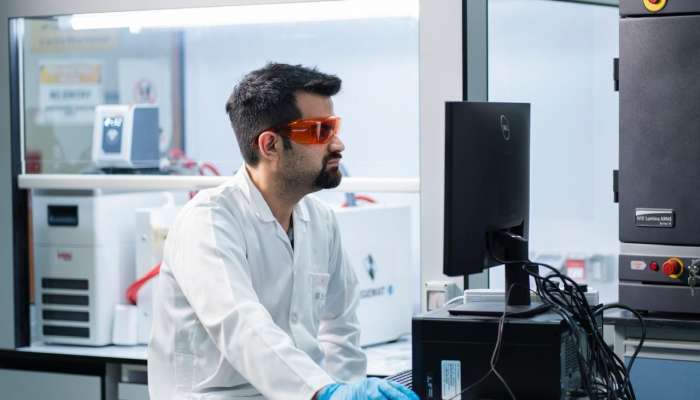
An innovative research project conducted at the University of Nizwa is offering a promising new approach to treating chronic wounds, particularly those associated with diabetes. The study, titled “Engineered local delivery of extracellular vesicles loaded with si-TNF-α, via a core-sheath 3D-bio-printed scaffold as an effective wound dressing,” was recently awarded the National Research Award 2025, organized by the Research and Innovation Authority in the Health and Social Services field under the Young Researcher category. Led by Mr. Saeid Vakilian, Associate Researcher at the Laboratory for Stem Cells and Regenerative Medicine, the research focuses on developing an advanced wound dressing that targets inflammation at its source and promotes faster healing.
According to Mr. Saeid, chronic wounds are often difficult to treat due to persistent inflammation, which can delay healing and lead to serious complications such as infections or even amputations. To address this challenge, the research team designed a novel solution that combines nanotechnology, gene therapy, and 3D bioprinting. The approach uses tiny particles naturally released by cells, known as extracellular vesicles, which are engineered to carry a therapeutic molecule called si-TNF-α. This molecule works by reducing excessive inflammation through targeting a key protein, TNF-α, that is commonly associated with chronic wounds.
Mr. Saeid explains that these engineered vesicles are incorporated into a specially designed 3D-printed scaffold that mimics natural tissue. The scaffold is designed to gradually degrade, allowing for controlled and localized release of the therapeutic vesicles directly at the wound site. Laboratory results demonstrated that the system effectively regulates the release of these particles and helps shift immune cells toward a healing state.
Further testing in animal models showed that wounds treated with this advanced dressing healed significantly faster than those treated with standard methods or non-loaded scaffolds. The treatment also reduced inflammation levels and improved overall tissue regeneration, indicating strong potential for clinical application.
The research findings highlight the successful integration of advanced biological and engineering techniques, including the effective loading of therapeutic molecules into extracellular vesicles while preserving their function, as well as the development of a stable and efficient 3D-bioprinted scaffold. Together, these innovations contribute to a more targeted and effective wound healing strategy.
The study has been published in the Journal of Drug Delivery Science and Technology. The research team includes Mr. Saeid Vakilian, Dr. Fatemeh Jamshidi-adegani, Mr. Fahad Al Fahdi, Ms. Zahra Mirsanei, Ms. Juhaina Al Kindi, Mr. Khamis Al Riyami, Dr. Nasar Al Wahaibi, Dr. Asem Shalaby, Prof. Ahmed Al Harrasi, Dr. Niyaz Al Sharabi, Prof. Kamal Mustafa, and Dr. Sulaiman Al Hashmi.
Reflecting on the achievement, Mr. Saeid Vakilian emphasized the significance of the recognition, stating, “Winning the National Research Award means a great deal to me. It is a strong validation of our team’s dedication and innovative work in addressing real-world health challenges such as chronic wounds. It motivates us to continue advancing research in stem cell and regenerative medicine, and highlights the importance of collaboration in developing solutions that can improve healthcare outcomes in Oman.”