Thursday 30 / July / 2026
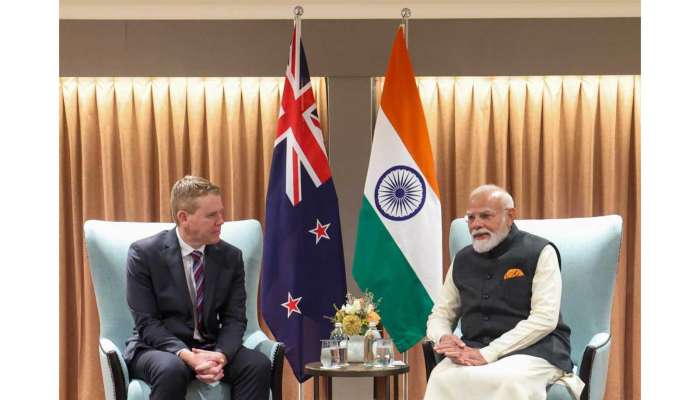
AUCKLAND: Indian Prime Minister Narendra Modi's historic visit to New Zealand on July 10–11 has marked a turning point in bilateral relations, with the two countries elevating ties to a full Strategic Partnership and setting an ambitious target to double two-way trade to NZ$7 billion (about $4.2 billion) by 2030.
The visit, the first by an Indian prime minister in four decades, saw Modi and New Zealand Prime Minister Christopher Luxon unveil a four-year Roadmap to 2030, expanding cooperation across defence, maritime security, trade, agriculture, tourism, science, sports, culture and people-to-people exchanges.
The enhanced partnership builds on the India–New Zealand Free Trade Agreement (FTA), signed on April 27, 2026, which is expected to enter into force before the end of the year after legislative approval in both countries.
Trade relationship poised for expansion
India has become an increasingly important economic partner for New Zealand. In the year ending December 2025, two-way trade reached NZ$3.95 billion (approximately $2.4 billion), with India ranking as New Zealand's 11th-largest export destination for goods and services combined.
New Zealand exported NZ$2.03 billion worth of goods and services to India during the period, making India its fifth-largest services market and 21st-largest destination for goods.
Both governments believe these figures represent only a fraction of the relationship's long-term potential. India's rapidly expanding economy, projected to become the world's third largest by 2030 with an estimated GDP of around $7 trillion, alongside a middle class expected to exceed 700 million people, offers significant opportunities for New Zealand exporters.
FTA to remove major trade barriers
Under the agreement, New Zealand will provide immediate duty-free access for all Indian exports, while India will eliminate or reduce tariffs on products representing about 95 per cent of New Zealand's current exports. Sensitive sectors, including dairy and selected agricultural products, will remain protected.
Described by India's commerce ministry as a "once-in-a-generation agreement," the FTA was concluded within nine months after negotiations resumed in March 2025, making it one of India's fastest-negotiated trade deals.
Both governments expect the agreement to become operational before the end of 2026.
Defence and maritime cooperation strengthened
The two countries signed a Mutual Logistics Support Arrangement, enabling the Indian Navy and the New Zealand Defence Force to use each other's facilities for refuelling, replenishment and maintenance during deployments.
A separate Memorandum of Arrangement on Maritime Cooperation will strengthen dialogue, operational coordination and information sharing across the Indo-Pacific.
The partners also agreed to establish a Maritime Security Dialogue, while New Zealand will lead the maritime-security pillar of India's Indo-Pacific Oceans Initiative, focusing on combating illegal, unreported and unregulated fishing.
A new Joint Working Group on Counter-Terrorism will further enhance intelligence sharing and security cooperation.
Recognition of Māori interests
The FTA includes New Zealand's standard Treaty of Waitangi clause, preserving the government's ability to meet its obligations to Māori.
It also features a dedicated chapter covering cultural trade, traditional knowledge and traditional medicines, including rongoā Māori, making it one of the more distinctive provisions in a modern trade agreement.
The deal is expected to benefit Māori-owned businesses, particularly exporters of mānuka honey, which will receive a 75 per cent reduction in India's current 66 per cent tariff over five years. Tariff reductions for forestry and sheep meat products are also expected to create new opportunities for Māori enterprises.
Indian diaspora remains a vital link
New Zealand's Indian community, numbering around 300,000 people and accounting for approximately six per cent of the country's population, continues to play an important role in strengthening bilateral ties.
Prime Minister Christopher Luxon described the Indian diaspora as central to the relationship between the two countries, while Modi referred to the community as a "living bridge" connecting India and New Zealand.
Strategic significance
The partnership reflects broader geopolitical priorities in the Indo-Pacific, where both countries support a rules-based regional order, secure maritime trade routes and closer regional cooperation.
For New Zealand, stronger ties with India also support efforts to diversify trade beyond traditional dependence on China, while for India the relationship complements its expanding engagement across the Indo-Pacific.
The immediate agenda includes completing FTA ratification before the end of 2026, launching the first Maritime Security Dialogue later this year, and beginning joint agricultural cooperation in early 2027 focusing on food safety, cold-chain technology, sustainable dairy production and horticulture.
Modi's landmark visit has given India–New Zealand relations renewed momentum and established a broader strategic framework that extends well beyond trade, laying the foundation for deeper economic, security and people-to-people cooperation in the years ahead.