Tuesday 29 / September / 2026
Geneva: The Sultanate of Oman has achieved notable progress in the innovation inputs pillar of the Global Innovation Index 2026 report, advancing 8 places to rank 47th globally, compared with 55th last year. This reflects the foundations, policies and programmes supporting innovation and the promising investment environment.
Oman remained stable at 69th globally in the overall ranking. The index, issued annually by the World Intellectual Property Organization (WIPO), measures 139 economies worldwide this year.
The report's findings indicated that 15 of Oman's sub-indicators within the overall index ranked among the world's top 40 countries. For example, Oman ranked 9th globally in net foreign direct investment inflows as a percentage of GDP, 14th globally in the level of development of specialized clusters, and 16th globally in electricity output per million population.
It also ranked 18th in the policy stability for doing business indicator, 20th in the information and communications technology access indicator, 22nd in the proportion of graduates in science, technology, engineering and mathematics programmes, 24th in the entrepreneurship policies and culture indicator, and 26th in the university-industry research and development collaboration indicator.
The results of the index's pillar rankings at the level of the Sultanate of Oman showed progress in 6 of 7 pillars. The institutions pillar was the strongest performer, reaching 39th place, supported by policy stability and an effective regulatory environment. It was followed by the infrastructure pillar at 54th, then the market sophistication pillar at 58th, advancing 12 places from last year.
The report clarified that there were qualitative leaps in some of Oman's indicators globally. The most prominent was a notable rise in the indicator of the number of venture capital deals received per billion dollars of GDP at purchasing power parity, advancing 32 places. It also advanced 32 places in the industrial designs by country of origin per billion dollars of GDP at purchasing power parity (PPP) indicator, and advanced 25 places in the indicator of the proportion of research talent working in the business sector.
Oman advanced in the indicator of the proportion of research and development expenditure financed by the business sector out of total research and development expenditure by 23 places, reaching 33rd globally. Oman's ranking also advanced in the indicator of the top 3 universities in the QS World University Rankings by 16 places, as a result of Sultan Qaboos University advancing to 334th globally and the entry of the University of Nizwa and Dhofar University into the top 1000 universities.
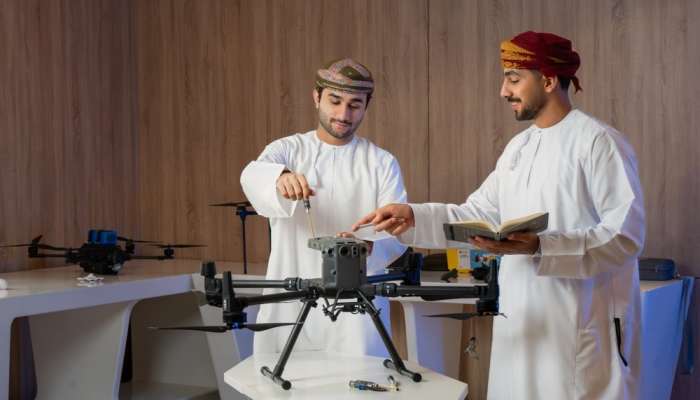
In line with the strategic focus of this year's report on "entrepreneurship in deep science," the report highlighted iLab Marine, one of the outputs of the programme to convert student graduation projects into startups affiliated with the Research and Innovation Authority, and Innotech as two leading national models in converting research and innovations into projects with economic feasibility and high added value, and the first national presence within the deep science startups tracker.
It is worth noting that the Global Innovation Index represents a strategic tool to help policymakers around the world measure and understand the strengths and progress of their national innovation systems, thereby supporting sustainable development paths based on knowledge and innovation.