Sunday 05 / April / 2026
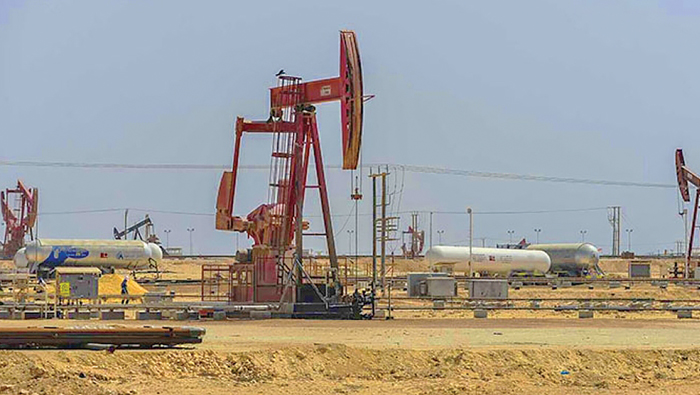
Muscat: Higher oil prices and better rates of oil and gas production in Oman are likely to provide a boost to the economy during the end of this year and most of the next, a new report has said.
The Middle East Monitor for November 2018, released by Fitch Solutions, said that economic growth will pick up, directly leading to better financial conditions for people in Oman. “Economic growth will pick up over the coming quarters owing to higher hydrocarbon production,” said the report. “Natural gas has provided most of the growth momentum in the year till date, thanks to the start of production at the Khazzan field in September 2017, with total national output expanding by 10.8 per cent between January and July.”
Financial analysts and economists said this growth would lead to the government pressing ahead with many social and economic development programmes to help residents and citizens in the country and further negate the effects of the downturn.
Fabio Scacciavillani, Chief Economist of the Oman Investment Fund, said this would provide an impetus to the economy.
“In real terms, any downturn has two elements. There is an element of increased efficiency of public expenditure and bureaucracy, and the other is a cut in services and the increase of taxes. In Oman, we have seen lowered subsidies, but have not seen a decrease in the provision of public services and we have seen a slowdown in the investment of new projects. Going forward, I think the efficiency of the civil sector will continue or there will be better tools such as online services and streamlined procedures, so, that will likely continue,” he said.
“In terms of taxes, I think that at this point, the planned increase in taxes will be put on hold, and the third element is that some infrastructure projects might come up on the priority list. For the man on the street, there will be some benefits because there will be more workers, more purchasing of cement and building materials, so these companies will do better and this will stimulate the economy and filter down to a large portion of society,” he added.
Mubeen Khan, a Muscat-based analyst, said: “I had said two months ago that oil prices would touch at least US$90 by the year-end when the crude prices were hovering between $70 and $75 a barrel. This was based on upcoming geopolitical challenges, demand and supply equations and lack of investments in the oil and gas sector. We recently saw Dubai Mercantile Exchange (DME) indices touching $88 per barrel, whereas Brent has breached $85 per barrel.”
Social welfare
“Falling crude prices after 2015 saw the government cutting down development expenditure while maintaining its social welfare outlay on health, education and defence. This was done without compromising the quality of services being provided to the citizens and residents. The cut in development expenditure was surely reflected in slowing down the construction and related sectors but now it is poised to grow,” he added.
“The improving crude prices is good news for the common man,” added Khan. “This will encourage the government to spend more, thus stimulating private sector growth and presenting more job opportunities and employee welfare. We must also remember that the government still provides subsidies for electricity and water.”
In addition, Ramanuj Venkatesh, a financial analyst with experience in both Oman and the UAE, said this would help the government push on with its economic diversification plan.
“In terms of what this means for the common man, the rise in price of hydrocarbons definitely incentivises the government to go for more rationalisation of its expenditure, and keep inflation at bay,” he told Times of Oman. “The government is taking a very important step in benefiting the common man by ensuring proper employment opportunities are provided, as well as ensuring there is proper financial backing for these local enterprises to ensure people are well educated and prepared for taking up more private sector jobs.”
“Of particular note is that there have been many new contracts for oil exploration, and there are many other important drilling projects, such as the Lekhwair field, the Rabab Harweel integrated project and the Yibal Khuff Project, so you can be assured that oil is pumped at a faster rate and cheaper cost,” said Venkatesh. “This helps in increasing and boosting the GDP of Oman in the long run in the form of sustained growth in the economy.”
The report from Fitch added: “Meanwhile, oil output, which was cut in 2017 as part of an OPEC/non-OPEC supply restraint deal, has yet to recover,” added the report. “Nevertheless, our oil & gas team expects Omani production to rise over the coming quarters, forecasting 0.5 per cent growth in 2018 and 3.0 per cent in 2019, as higher oil prices lead the OPEC/non-OPEC countries to ease output curbs.”
“Given that oil and natural gas accounted for 41.1 per cent of real GDP in 2016, the higher forecast output will offer an impetus to headline growth,” said the report.