Saturday 09 / May / 2026
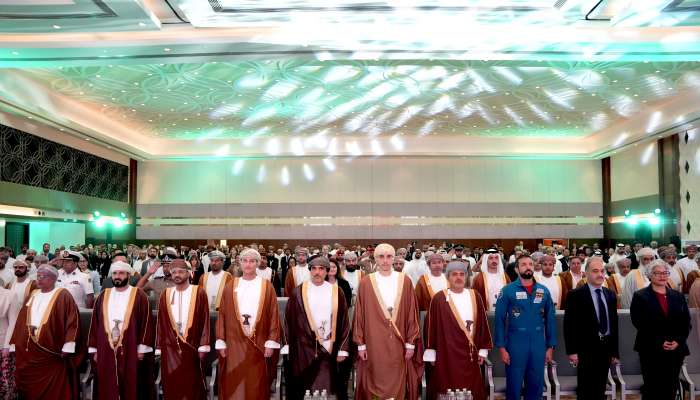
Muscat: The second edition of the Middle East Space Conference, hosted by the Sultanate of Oman, began today at the Oman Convention and Exhibition Centre.
As many as 500 experts and CEOs in the space sector from government agencies and private sector companies representing 30 countries, in addition to more than 85 speakers are taking part in the event.
The opening of the conference was held under the patronage of HH Sayyid Dr. Kamil bin Fahad Al Said, Secretary General at the Secretariat General of the Council of Ministers.
Over three days, the conference will focus on several objectives, most notably: providing a platform that brings together decision-makers to enhance space diplomacy by encouraging international and regional cooperation to transfer expertise and localise best practices; attracting experts and investors to explore promising investment opportunities at the local and regional levels; highlighting the Sultanate of Oman’s position as a leading regional gateway for space services and applications supporting economic diversification; in addition to transferring and localising space knowledge and technologies and building national capacities to ensure the sustainable growth of the sector.
Dr. Ali Amer Al Shethani, Undersecretary of the Ministry of Transport, Communications, and Information Technology for Communications and Information Technology, stated: “The space sector in the Sultanate of Oman represents a qualitative leap and accelerated growth, resulting from a clear national vision, enlightened by the wise leadership of His Majesty Sultan Haitham bin Tarik Al Said and the sound implementation of the strategic initiatives outlined within the framework of the National Policy and Executive Program for the Space Sector (2023–2033), which was launched with Royal blessings in January 2023.”
In his speech, he added that the Ministry of Transport, Communications, and Information Technology, represented by the National Space Programme, in cooperation with its local and international partners, has dedicated diligent efforts across various fundamental axes to develop the space sector, especially in the field of building national capacities, scientific research and innovation, and entrepreneurship.
He pointed out that the Sultanate of Oman has become a “model hub” for the space world in general, and the region in particular, since the previous edition of the conference in January 2024. This is thanks to the successful experimental launch of a rocket from the experimental launch platform in the Wilayat of Duqm in Al Wusta Governorate, which created a wide resonance in the global space sector and turned ambitions into reality.
He reviewed the signing of the agreement for “Designing, Manufacturing, and Launching the Omani Communications Satellite” with Airbus Defence and Space, considering it one of the enabling and accelerating projects for the growth of the space sector, empowering local institutions operating in the sector, and maximizing the local value added from the project.
He noted that field surveys have shown clear growth of this sector in the Sultanate of Oman since the launch of the policy until the end of 2025, as the number of companies operating in the sector doubled, investments rose by 200 percent, leading to a threefold increase in the number of available jobs within it. Consequently, the sector’s contribution to the comprehensive development of the digital economy increased.
The Undersecretary stated that the space economy in recent years has surpassed the barrier of $600 billion, with expectations to reach about $1.8 trillion by 2035, driven by the shift towards low Earth orbit, the increasing role of the private sector, and the emergence of new space services such as in-orbit servicing and manufacturing in microgravity environments. This makes space a pivotal element in sustainable development and future economies.
For his part, Pacôme Révillon – CEO of Novaspace, stated that the conference proceedings embody the Sultanate of Oman’s keenness to enhance the status of the space sector as a strategic pillar for national development and a promising path for long-term sustainable progress. Stemming from a clear vision represented in supporting regional cooperation and promoting innovation in the space sector across the Middle East.
He added in his speech that over the next three days, the conference sessions, with the participation of an elite group of decision-makers from governments, agencies, and industrial institutions, will discuss ways to employ space capabilities to serve national and regional priorities. The discussions will include multiple topics, ranging from national strategies and regulatory frameworks, through infrastructure and services, to education, research, and innovation, reflecting the breadth of dimensions of the space sector and its renewed dynamism.
The, HH Sayyid Dr. Kamil bin Fahad Al Said, Secretary General at the Secretariat General of the Council of Ministers, and Eng. Said bin Hamoud Al Maawali, Minister of Transport, Communications, and Information Technology, crowned the winners of Oman Space Accelerator Program, which attracted 10 startups within an intensive program lasting 15 weeks, including specialized technical and commercial training and mentorship from local and international experts.
The proceedings of the first day of the conference included the signing of two agreements: The first, the “Artemis Accords,” an international agreement between the Sultanate of Oman and the United States of America, aiming to enhance cooperation in the peaceful exploration of space, regulate partnerships related to the return to the Moon, prepare for future missions to Mars, and establish common frameworks for civil space activities. It is expected to enhance the Sultanate of Oman’s position on the global scientific and technological exploration map and open wide horizons for youth and researchers in space sciences and future applications.
The second agreement came in the context of supporting strategic partnerships in the space services sector, as an agreement was signed between the Omani Telecommunications Company “Omantel” and OQ Gas Networks, aiming to provide satellite services for monitoring and controlling gas pipeline networks.
On the sidelines of the conference, an exhibition was held featuring more than 50 local and international companies specialized in space technologies and sciences, aiming to bring together service and technology providers and users to exchange expertise, build effective partnerships between actors in the sector’s supply chain, in addition to attracting investment opportunities, establishing new commercial partnerships, and raising awareness about technological progress in the space industry.
The conference included a number of sessions and papers on the space sector, including: Space Strategies in the Middle East from Ambition to Reality, Seizing Investment Opportunities in the Omani Space Sector, Building Cross-Border Partnerships from the Perspective of Global Space Agencies, Building International Partnerships to Advance the Space Industry, Enabling Access to Space in the Middle East, Developing the Next Generation of Space Infrastructure, and Financing Future Horizons.
Meanwhile, the MB Group of Companies and the global company Eutelsat signed an agreement to enhance satellite communication services in the Sultanate of Oman, supporting the objectives of Oman Vision 2040 and providing secure, resilient, and sustainable connectivity that raises the readiness of the national digital infrastructure and supports the digital economy and economic diversification.
Mahfooz Salim Al Sheikh, Deputy CEO of “Diraa” Company, specializing in defense and space communications, stated that the agreement aims to design, build, and launch a large macro-geostationary satellite of the type MB-Sat-1 into orbit and begin providing satellite communication services in early 2027.
He added in a statement to Oman News Agency that the agreement covers the satellite’s geographic footprint for the entire Middle East region in addition to the Sultanate of Oman. The main hub and infrastructure will be located within the Sultanate of Oman, with additional ground stations and contact points geographically distributed around the region to support customers and core operations.