Thursday 29 / January / 2026
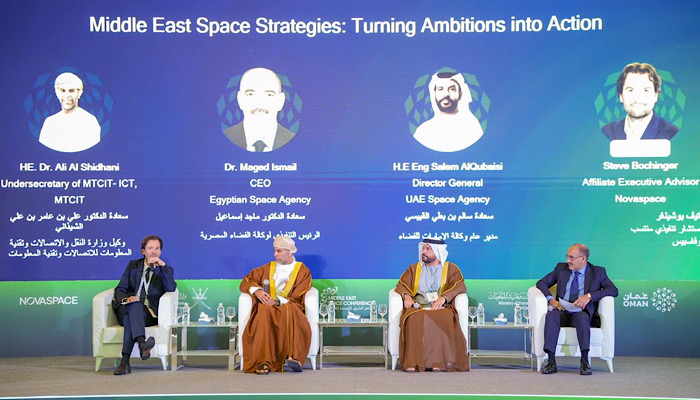
Muscat: The Middle East Space Conference 2026 concluded after three days of high-level discussions in Muscat, marking a significant milestone for the region’s growing space sector and reinforcing Oman’s ambitions to become a regional hub for space sciences and technologies.
Organised by the Ministry of Transport, Communications and Information Technology (MTCIT), the conference brought together decision-makers, senior officials, industry leaders, academics, researchers and university studentsfrom across the region and beyond. A total of 85 speakers participated, presenting papers and engaging in in-depth discussions on the future of space sciences, infrastructure development and emerging technologies.
The conference featured 17 panel discussions and 15 keynote speeches and specialised dialogues, outlining strategic pathways for the development of the space sector in the Middle East.
Five Strategic Agreements Signed
Five major agreements were signed during the conference, reflecting a strong push toward international cooperation and private-sector engagement.
Foremost among them was the signing of the Artemis Accords, an international agreement between the Sultanate of Oman and the United States, aimed at enhancing cooperation in the peaceful exploration of space. The agreement supports collaboration related to lunar missions, future exploration of Mars, and the establishment of shared frameworks for civil space activities, strengthening Oman’s position on the global scientific and technological map.
In the commercial space services sector, Omantel signed an agreement with OQ Gas Networks (ATCO) to provide satellite services for monitoring and surveillance of gas pipeline networks. In another landmark deal, the Mohammed Al Barwani Group signed a strategic agreement with US-based Astranis to develop Oman’s first MicroGEO communications satellite.
Two additional agreements were also concluded. The first, between Adasat Oman and ATCO, focuses on Earth observation and remote sensing services. The second, a partnership between Sohar University and ATCO, aims to build national capabilities and facilitate knowledge transfer in satellite systems and artificial intelligence–driven data analysis.
Strategic Recommendations for the Space Sector
The conference concluded with a set of strategic recommendations aligned with Oman’s National Space Policy, highlighting the importance of the next phase of sector development.
Key recommendations included establishing clear and transparent institutional governance for the space sector to enhance investor confidence, and developing a flexible and enabling legislative and regulatory framework that keeps pace with rapid technological advancements and evolving business models.
Participants also stressed the need to continue investing in national capacity building, localisation of knowledge and technology through training programmes, and expanding regional and international partnerships, recognising the space sector as an ecosystem driven by technology, capital and expertise.
The recommendations further called for a stronger government role in stimulating market growth, particularly through public procurement policies that support national companies providing space-based services. Emphasis was placed on deploying space applications to serve national priorities such as urban planning, food and water security, disaster management, environmental protection, transport and smart cities, reinforcing the sector’s contribution to sustainable development.
Arab Space Cooperation Meeting Held in Muscat
On the sidelines of the conference, Oman hosted the 12th meeting of the Arab Space Cooperation Group, the first such meeting to be held in Muscat. The meeting was chaired by Dr. Magued Ismail, representing the Arab Republic of Egypt, and attended by representatives from nine Arab countries, including Oman, the UAE, Bahrain, Kuwait, Lebanon, Morocco, Iraq and Jordan.
Regional Leaders Praise Conference Outcomes
Dr. Mohammed Ibrahim Al Asiri, CEO of Bahrain’s space agencies, said the 2026 edition witnessed a significant expansion in both the number of participating partners and companies, reflecting the rapid growth of Oman’s space sector. He highlighted the strong cooperation between Oman and Bahrain, supported by a memorandum of understanding signed more than two years ago, and noted continued coordination in regional and international forums.
Salem Butti Al Qubaisi, Director General of the UAE Space Agency, described the 2026 edition as a “qualitative leap” compared to the previous conference, citing growth in the accompanying exhibition and the high quality of technical papers presented. He emphasised the importance of positioning the GCC region as a key driver of the global space industry.
Meanwhile, Dr. Magued Ismail, CEO of the Egyptian Space Agency, said the conference produced valuable results and provided an important platform to learn about Oman’s space programmes, including OmanSat-1, the agreement with Airbus Defence and Space to design and manufacture Oman’s first communications satellite.
Launch of National CubeSat Programme
During the conference, the official launch of a national CubeSat development and assembly programme was announced. Adasat Oman revealed that the programme aims to build national capabilities in satellite manufacturing through the development of an AI-enabled CubeSat, in collaboration with several academic institutions across the Sultanate.
The initiative forms part of the National Space Programme under MTCIT and aligns with Oman’s broader strategy to localise space technologies and establish a sustainable national knowledge base.




