Saturday 22 / August / 2026
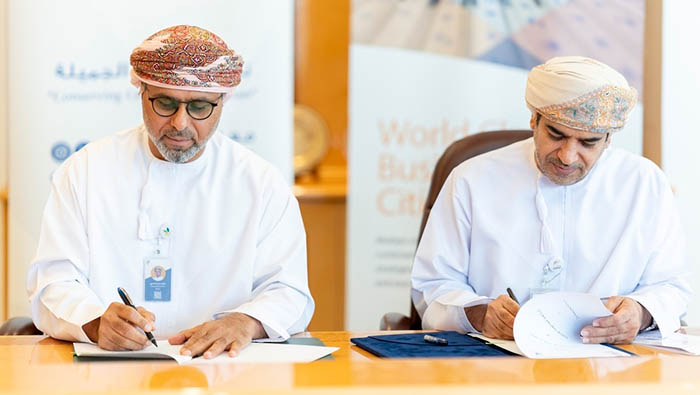
Muscat: The Public Establishment for Industrial Estates (Madayn) and Oman Environmental Services Holding Company (be’ah) signed a cooperation programme aimed at strengthening industrial waste management and treatment.
This partnership aligns with the national efforts for environmental protection and sustainability development through regulating and developing mechanisms for handling industrial and hazardous waste generated by manufacturing activities in Madayn’s industrial cities.
The cooperation programme was signed by Eng. Dawood bin Salim Al Haddabi, CEO of Madayn, and Eng. Tariq bin Ali Al Amri, CEO of be’ah.
Commenting on the significance of this partnership, Eng. Ibtisam Al Shanfari, Environmental Affairs Specialist Director at Madayn, stated that the cooperation programme forms part of broader efforts to advance environmental sustainability across the industrial cities. She noted that the programme aims to develop an integrated waste management system in line with approved environmental standards, increase recycling rates, and reduce waste sent to landfills.
“This partnership also aims to ensure the commitment of industrial units to the regulations, lower the carbon footprint through implementing innovative solutions such as material and energy recovery, and enhance a culture of sustainability among investors and employees through specialised awareness and training programmes,” she pointed out.
Al Shanfari added that signing the cooperation programme represents a qualitative step toward promoting the circular economy and achieving Sustainable Development Goals. “In light of the accelerating environmental challenges facing the world, environmental sustainability has become an indispensable strategic priority, particularly in the industrial sector, which is one of the most significant sources of waste and emissions. From this standpoint, the signing of a waste management cooperation programme with be’ah underscores the importance of addressing industrial waste management as a key challenge facing the industrial cities today,” she elaborated.
It is worthwhile to mention that the cooperation programme establishes a joint framework to define the scope of collaboration and execution mechanisms between the two bodies. This includes the registration of the investing companies within the industrial cities into be’ah’s systems and the application of the ‘Manifest System’ prior to transporting waste to treatment facilities. The programme also organises waste routes and ensures that waste is sorted, classified, and repackaged according to approved specifications.
As part of the programme, be’ah will provide specialised technical support in classifying and evaluating industrial waste, determining treatment costs, and providing data on waste received at treatment facilities to ensure transparency and efficiency. In addition to technical support, the programme facilitates joint inspection requests related to waste disposal processes to ensure full adherence to local and international environmental laws.