Wednesday 29 / April / 2026
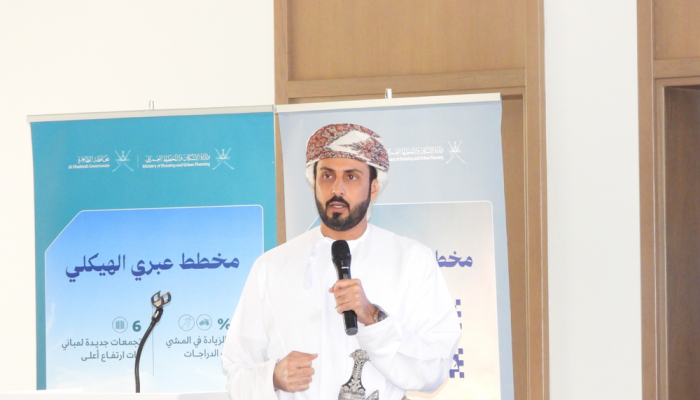
Ibri--- The Wilayat of Ibri celebrated today the inauguration of the Ibri Structural Plan at the new headquarters of the Directorate General of Housing and Urban Planning in A’Dhahirah Governorate.
The ceremony was held in the presence of Dr. Khalfan Said Al Shuaili, Minister of Housing and Urban Planning.
During the event, Tahir Mabkhout Al Junaibi, Governor of A’Dhahirah, delivered a speech highlighting the project's significance, noting that the structural plan is a key output of the Regional Urban Strategy for A’Dhahirah Governorate.
He emphasized that the launch of the Ibri Structural Plan represents a pivotal milestone in the governorate’s development trajectory, as it establishes an integrated developmental framework and sets clear foundations for city growth according to a long-term strategic vision. This plan enhances the integration of economic, social, and environmental aspects, thereby increasing resource efficiency and achieving a balance between growth requirements and quality of life.
The Governor pointed out that the plan embodies a direction toward building a regional city capable of absorbing future transformations by diversifying the economic base, enhancing investment attractiveness, and developing infrastructure and services to create an integrated urban environment that stimulates growth.
He affirmed that this approach will consolidate the Wilayat of Ibri’s position as an active developmental hub at the governorate level and a primary supporter of the local economy. He added that the plan's execution will rely on an integrated approach based on coordinating efforts between various government and private entities within a unified institutional framework, ensuring efficient implementation and accelerating the pace of achievement. This integration will align projects with developmental priorities, enhance resource allocation efficiency, and achieve harmony between sectoral plans, positively impacting service quality and development sustainability.
The plan aims to accommodate more than 121,000 people by the year 2040 while addressing existing challenges related to dispersed population clusters, unbalanced growth, and fragmented infrastructure. It seeks to achieve this by regulating urban expansion, revitalizing the city center, enhancing the urban landscape, and building an integrated urban structure that keeps pace with future growth requirements.
The plan is based on five main strategic objectives: Green Ibri, Connected Ibri, Resilient Ibri, Productive Ibri, and Distinctive Ibri, seeking a comprehensive balance between urban development and environmental and economic sustainability.
The "Green Ibri" objective focuses on increasing the per capita share of open spaces to between 9 and 10 square meters, alongside developing parks extending along wadi paths and a regional park to enhance the quality of the urban environment.
"Connected Ibri" aims to develop an integrated transport system by providing 62 kilometers of bus routes and increasing the use of public transport and bicycles to enhance mobility efficiency.
Through "Resilient Ibri," the plan works to develop neighborhoods suitable for walking and active movement via integrated communities and a linked local road network, in addition to establishing six new residential clusters and enhancing the city’s readiness to deal with natural risks by organizing 11 kilometers of wadi channels.
"Productive Ibri" focuses on enhancing economic productivity by identifying eight specialized economic clusters including food industries, light industries, logistics, energy, education and skills development, as well as tourism and civil services, contributing to sustainable job creation.
The plan also reinforces the wilayat’s role as an agricultural catalyst supporting food security through policies to improve water use efficiency and develop agricultural industries.
Finally, "Distinctive Ibri" seeks to revive cultural heritage within the urban system by protecting historical sites and developing heritage trails, thereby strengthening local identity and transforming cultural heritage into an active element in tourism and economic development.
During the inauguration, a package of executive projects for the plan was reviewed, exceeding 190 projects implemented by more than 30 government and private entities within a unified coordination framework. The first phase includes more than 100 projects covering multiple fields such as infrastructure, sustainable transport, resource management, digital transformation, energy, and the agricultural and industrial sectors, as well as urban landscape development and community services.
Prominent strategic projects within this package include upgrading the efficiency of Sultan Thuwaini Road, developing the Industrial City, the Ibri Project, the Ibri Historical Center, the development of Ibri Souq, the Science and Innovation Center, and the Regional Park.
The plan emphasizes the importance of community partnership, with more than 560 participants from various sectors and over 35 government and private entities involved through more than 90 workshops and specialized meetings aimed at aligning the plan’s outputs with national and sectoral strategies.