Sunday 20 / September / 2026
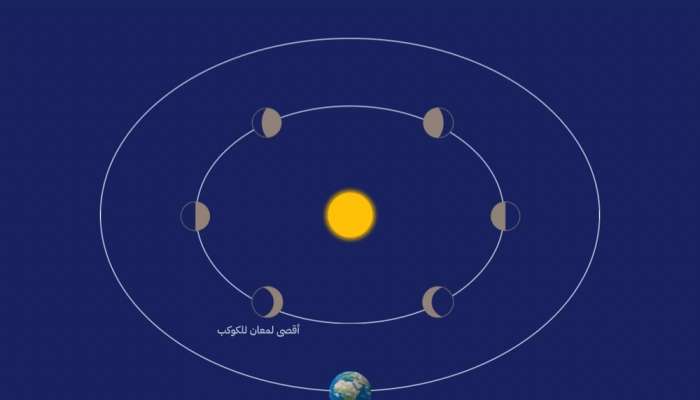
Muscat: The skies over the Sultanate of Oman will witness, this Tuesday, Venus shining at its maximum brilliance during its current evening apparition, with its apparent magnitude reaching approximately (−4.8), making it appear as the brightest planet in the sky and the third brightest celestial body visible from Earth after the Sun and the Moon.
Wissal Salim Al Hinai, Chairperson of the Community Communication Committee at Oman Astronomical and Space Society, stated in a remark to Oman News Agency (ONA) that Venus is distinguished by its striking brightness in the sky and appears during this period as an intensely luminous point readily visible to the naked eye, even amid light pollution. She explained that this brightness is attributable to its relative proximity to Earth and its high capacity to reflect sunlight.
She added that Venus's maximum brilliance does not necessarily coincide with its greatest angular distance from the Sun in the sky, noting that the planet reached its greatest eastern elongation during August, the phase at which it attained its largest angular distance east of the Sun as seen from Earth, and that it therefore appeared clearly in the evening sky after sunset.
She called upon those interested in astronomical phenomena to observe Venus from locations with an unobstructed western horizon, away from buildings and elevations that might obscure visibility, noting that naked-eye observation requires no special astronomical equipment, while telescopes permit viewing of its crescent phase and the details of its apparent form.
Venus is the brightest planet of the solar system as seen from Earth, conventionally known as the "Evening Star" when it appears after sunset and the "Morning Star" when it appears before sunrise, deriving its brilliance from sunlight reflected off its dense atmosphere.